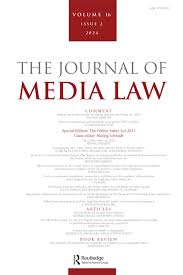
 The Journal of Media Law has published a special issue on “Making Public Allegations: Media Law in its Social Context” (currently open access). The collection asks how media law can create settings which both protect due process and deserved reputation and allow truth-tellers to expose harm and warn other would-be victims. These issues are explored in a range of contexts and jurisdictions.
The collection starts with a series of articles asking who media law is affecting and how. These articles look particularly at gender, arguing that an under-acknowledged recalibration towards reputation is affecting women’s ability to speak out about discrimination and violence. In their analysis of the gender implications of recent English defamation developments, Rebecca Moosavian and Peter Coe argue that defamation has been shaped by male interests. They claim, for example, that cases involving sexual and/or domestic violence reflect deep-rooted patriarchal gender dynamics. Judith Townend andJulie Doughty then present evidence of a gendered chilling effect on media law more broadly, examining decisions in privacy, defamation, family law, and criminal procedure to illustrate the point.
In her article, Ursula Cheer provides an empirical basis for understanding gender issues, analysing the role of gender in every reported defamation case from 2014 to 2024 in both New Zealand and England and Wales. Amy Gajda examines the long-term impact of making a #metoo-style allegation in the United States. She argues that a victim who accuses a powerful person of wrongdoing should be able to shake off public figure status once any media furore has calmed down.
Concerns about a recalibration towards the protection of reputation, at the expense of freedom of expression, also underpin the next two articles in the collection. John Campbell SC argues that the UK Supreme Court’s 2022 decision in ZXC v Bloomberg LP (which held that there is usually a reasonable expectation of privacy in respect of a police investigation into a person’s conduct) undermines both speech protections in the law of defamation and what the privacy action is actually about, namely the protection of private information.
Jeevan Hariharan addresses this recalibration from a different angle. He highlights exceptions and defences to prima facie protection against police-investigation disclosures, arguing that they need to be more clearly articulated and to receive more attention from commentators and litigants.
Both these papers reinforce the idea that, whilst judges need to address the cause of action pleaded before them, media law also needs to be understood as a whole. Fiona Brimblecomb addresses questions of coherence in her analysis of the public interest defence across the misuse of private information tort, defamation and data protection. She highlights commonalities but also inconsistencies in the way that concept is applied.
David Rolph’s article examines the truth defence across defamation, contempt, confidence and privacy arguing that defamation’s long-established truth protections should not be undermined by developments in privacy or any other media law action.
“Making Public Allegations” aims to facilitate the kind of joined-up thinking that is needed to encourage coherence between actions and to promote a balanced approach to the protection of deserved reputation, on the one hand, and the making of accurate public allegations on the other. This involves critical examination of the modern balance between reputation and other interests and a willingness to engage thoughtfully with the societal impacts of media law decisions.
Link to the collection here: https://www.tandfonline.com/toc/rjml20/17/2 All articles in the collection are open access until 30 November 2026.
N A Moreham, Professor of Law, Victoria University of Wellington and editor of the special collection


Leave a Reply