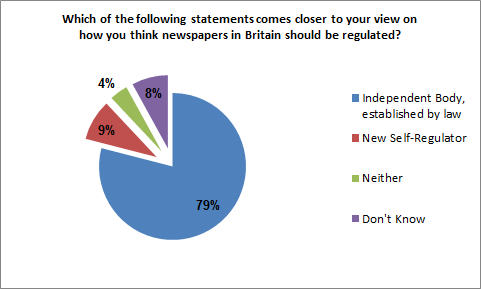
 A YouGov poll commissioned by the Media Standards Trust has found overwhelming public support for a new system of independent regulation, established by law. When asked how newspapers in Britain should be regulated, 79% chose the option “There should be an independent press regulator, established by law, which deals with complaints and decides what sanctions there should be if journalists break agreed codes of conduct”. Only 9% believe that newspapers should establish their own body to do this. Continue reading
The International Forum for Responsible Media Blog
Month: November 2012 (Page 2 of 7)
 On Thursday 22 November 2012, Fraser Nelson, the editor of the Spectator, wrote a piece on the Telegraph calling on the Prime Minister not to give in to demands for statutory regulation but to preserve Britain’s “317-year tradition of press freedom”. But his article fumbles the issues of power involved in the question of press regulation.
Nelson’s narrative is that journalists and politicians are at war, with the rebellious energy and noble disrespect of the press corps pitched against politicians eager to clamp down on any criticism: Continue reading
 The recent judgment of the Supreme Court inThe Rugby Football Union v Consolidated Information Services Limited (formerly Viagogo Limited) [2012] UKSC 55 provides a forceful restatement by the highest authority in this jurisdiction of the court’s power to grant third party disclosure orders under the principle originally laid down by the House of Lords in Norwich Pharmacal Co v Customs & Excise Commissioners [1974] AC 133.
 The Government has recognised when drafting clause 5 of the Defamation Bill that there is a need for individuals and companies to be able to complain effectively to internet intermediaries in respect of libellous content but that internet intermediaries need greater protection from liability for content for which they are not responsible. However, as discussed in the first part of this post, in trying to strike a balance between claimants’ reputations and freedom of speech, perhaps the most difficult issue is how to deal with anonymity. Continue reading
 The news of the week is that Leveson will report on 29 November 2012. A copy of the report will be available to download from the Inquiry website once it has been officially published. There has been a huge amount of comment in anticipation of his findings: for a small selection see: Steven Barnett in the Times Higher Education; Robert Peston at the BBC (who refreshingly admits “the defining characteristic of my knowledge of the Leveson report is that I don’t know very much“); Richard Ackland in the Sydney Morning Herald; further backlash at the Mail; and a Guardian editorial calling for “a small number of key changes” to the Hunt-Black plan. Professor Stewart Purvis has a 70 word summary here. Continue reading
 Despite the growing number of internet libel cases in recent years, most of the debate around libel reform has concerned the chilling effect of UK libel laws on the newspaper industry. However, there is perhaps a greater chilling effect happening as a result of European intermediary liability laws, which have led to internet intermediaries removing defamatory content without a great deal of scrutiny. At the same time, many genuine victims of online defamation are being left without a remedy due to the challenges of taking action against anonymous users. Continue reading
 As the date of publication of the Leveson report approaches the self-interested spin machine of the popular press is going into overdrive. Today’s “Mail on Sunday” headline was “Cameron set to defy Leveson on law to allow state-controlled press… for now.” The story, attributed to “senior sources”, was to the effect that the Prime Minister was Continue reading
 In a powerful piece on this blog, Charlie Beckett has argued strongly against what he calls “statutory newspaper regulation” and, with evident reluctance, has backed the “evil empire” of the British press. In this post I will argue that he is unrealistic and wrong. Continue reading
 One of the many issues to emerge as a result of the McAlpine saga is the question of how vulnerable users of social media like twitter might be under defamation law. Lord McAlpine is reported to be planning to sue up to 10,000 twitter users – and some famous individuals have already been named as among them: George Monbiot, Sally Bercow and Alan Davies. Continue reading
 It seems that like cockroaches, British newspapers can survive the nuclear explosion of phone-hacking, plummeting sales, vapourised advertising revenue, a variety of police investigations leading to multiple arrests, and the most searing, gob-smackingly revelatory investigation of their practice, ethics and purpose by a judge. Continue reading

Recent Judgments

© 2026 Inforrm's Blog
Theme by Anders Norén — Up ↑