 Super injunctions just for the rich and powerful? The Courts making it up a privacy law as they go along? Is that the impression you get from the media coverage of the current super injunction case? However, did you know that, in this case, the Court concluded that the question was more about blackmail than free speech? Did you know that the newspaper did not provide any evidence as to why the public interest was served by disclosure? Continue reading
The International Forum for Responsible Media Blog
Month: May 2011 (Page 4 of 5)
 In this week’s Anthony Sampson lecture 2011, the editor of the Guardian, Alan Rusbridger, went well beyond his title, ‘The long, slow road to libel reform’, and tried to show how defamation, privacy outrage, the scandal of phone hacking, and weak self-regulation are all connected. Continue reading
 The courts have described confidential information as an ice cube; give it to the person who has no refrigerator or who refuses to keep it in one and by the time of the trial, all you have left is a pool of water. This is the justification for a pre-publication injunction in privacy cases where one is rarely available in defamation: publish a libel and be damned later in damages if you defame in the process, because the victim can be ultimately vindicated by a jury verdict Continue reading
 Max Mosley has been unsuccessful in his long running campaign to compel the English press to give advance notice of threatened invasions of privacy. The Fourth Section of the Court of Human Rights today gave judgment in the case of Mosley v United Kingdom (Judgment of 10 May 2011). After a careful and detailed consideration of the relevant background and law the Court concluded that, having regard to the chilling effect of a pre-notification requirement in privacy cases and the margin of appreciation, there was no violation of Article 8.
 Re: L (A Child: Media Reporting) [2011] EWHC B8 (Fam) (18 April 2011). The thought of being personally criticised in a reported judgment would make most lawyers break into a cold sweat. Some journalists wear such treatment as a badge of honour. But surely it is professionally embarrassing for a High Court Judge to label an article as “unbalanced, inaccurate and just plain wrong“. That was the treatment handed out by His Honour Judge Bellamy to the Telegraph’s Christopher Booker in a recent ruling. Continue reading
 As the BBC’s technology correspondent has pointed out, speculation about the identity of privacy injunction claimants has been rife on Twitter for some time. Rory Cellan-Jones tweeted:
“Rather weird that Twitter has been alive with super-injunction details for weeks – but one new account with inaccurate reports is news.”
Despite that, the Daily Mail’s front page today proclaims ‘Gagging Law: Now Fiasco on Twitter’. Continue reading

News
Privacy law and “gagging orders” continue to command a high degree of media attention this week. There was the story (or perhaps non-story) about the “MP with a super-injunction”. We have already posted about this. There were news reports of another Continue reading
 “People have really gotten comfortable not only sharing more information and different kinds, but more openly and with more people”: not a controversial statement from Mark Zuckerberg on the impact of the internet on privacy. Not only are people more willing to share private information, the internet means what is shared can be spread to millions of people in a matter of seconds. It becomes interesting, therefore, at what point information published about an individual on the internet enters the so-called ‘public domain’ and is incapable of protection for privacy reasons. Continue reading
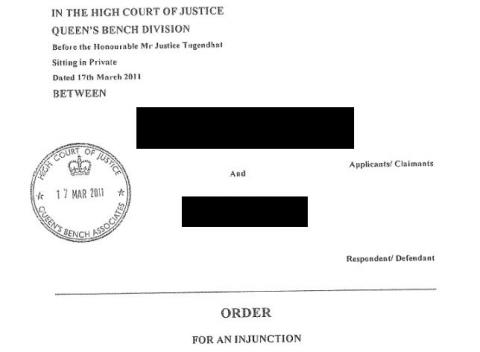 On Friday 6 May 2011, the “super-injunction saga” took a new twist: one MP had accused another of having “taken out a super-injunction”. The press headlines were clear “MP takes out super injunction, another MP claims” (the Mirror), “MP granted super-injunction” (the Independent, “MP accused of hiding ‘own shame’ behind a super-injunction” (the Guardian). As usual with press reporting in this area, the reality is very different. Continue reading
 Legal speakers at a libel reform debate at Queen Mary, University of London, were presented with this motion on Wednesday night: “This house believes that the English libel laws are unfit for purpose in the Twenty-First Century.” Despite the groundswell of support for the Libel Reform campaign – the impetus for the government’s and Lord Lester’s respective defamation bills – the four respondents all wished to speak against the motion. Continue reading

Recent Judgments

© 2026 Inforrm's Blog
Theme by Anders Norén — Up ↑