 In the last 3 years the Guardian has published over 200 articles relating to Trafigura, the vast majority of which have referred to the “super-injunction” which the company obtained against the newspaper and to Carter-Ruck’s apparent attempts to gag the reporting of Parliament. Despite this saturation coverage, some questions remain unanswered.
The International Forum for Responsible Media Blog
Month: October 2011 (Page 4 of 6)

 The Press Standards Board of Finance (PressBoF) announced today that Lord David Hunt will be the next chairman of the Press Complaints Commission . He will take up his appointment on 17 October 2011 – next Monday. Continue reading
 On 8 October 2011, Mr Justice Eady gave a speech entitled “How private is private?” to the “2011 Young Bar Conference“. The speech is a characteristically entertaining and informative tour of the privacy landscape, with a little gentle teasing of press and politicians along the way and a firm message about the relationship between parliament and the judiciary. Continue reading
 At Leveson Round One last week, “public interest” featured almost as much as “values” in Ed Miliband’s address to his party conference. As might be expected there were two essential views on offer. For Trevor Kavanagh of the Sun, the issue is, as might be expected, pretty clear cut: “Everything under the sun is of interest to the public, from a local fête to a sex-and-lies political scandal or the secret location of a nuclear device. One may be simply interesting while the others bump up against the sometimes contentious definition of “the public interest”. Continue reading
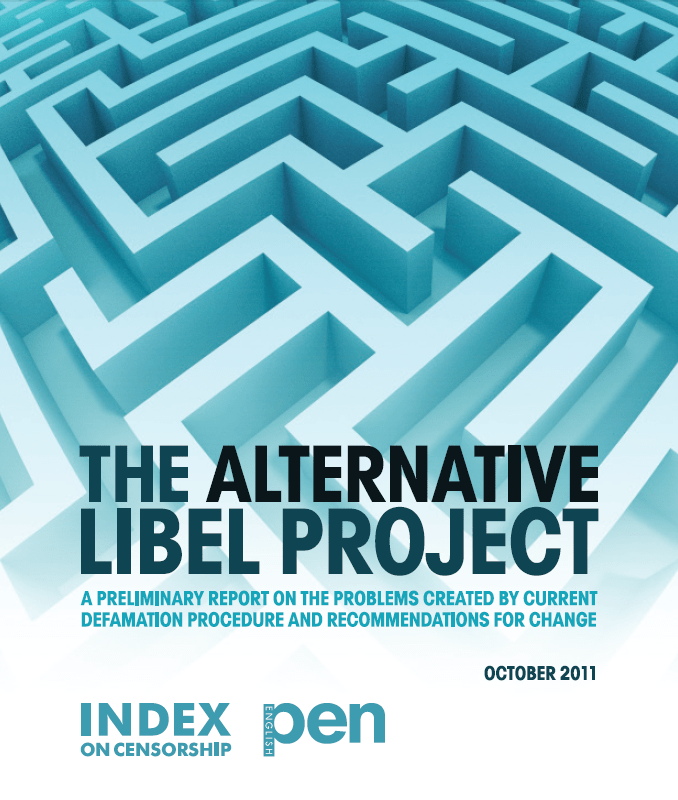 On Thursday 6 October 2011 the “Alternative Libel Project” launched its “Preliminary Report on the problems created by current defamation procedure and recommendations for change.” The report recommended that defamation cases should be mediated, and if they are not, they should be the subject of an early neutral evaluation by a High Court Judge. The report was prepared by Index on Censorship and English PEN and was funded by the Nuffield Foundation. Continue reading
 We begin, this week, with the Leveson Inquiry. It held its first two “seminars” on Thursday 6 October 2011, before a distinguished “media audience”. A presentations was given by Phil Hall – former News of the World editor, turned PR man – which the “Daily Telegraph” reported under the headline “Leveson inquiry: phone hacking was not caused by newsroom pressure” and the BBC had “Hacking not due to sales pressure”. Presentations were also given by Clare Enders (interesting statistics on the problems of the press in the digital age) and former “Star” journalist and trenchant tabloid critic Richard Peppiatt (his presentation impressed the Angry Mob blog). Continue reading
 The Press Complaints Commission is in the operating theatre and in a critical condition. It cannot compensate victims for serious breaches of its own Code nor can it mount proper investigations into press malpractice. It needs a major blood transfusion and a complete set of canine implants. Until it has some proper teeth it will remain the “watchdog with rubber dentures” and be the laughing stock of regulatory bodies. Continue reading
 The short answer to the first question is yes, there is a difference. Two distinct meanings of the word “interest” are at issue: in one we give our attention to something because it has the potential to do us good or harm; in the other we are merely curious. The distinction is explicit in the difference between the negatives: “disinterested” and “uninterested”. Continue reading
 Part One of this post appeared on 6 October 2011. It is based on his article “A right to delete?’, published in the European Journal of Law and Technology, Volume 2 No. 2, 2011, accessible here.
One of the principle aims of rights in general is to put power into the hands of individuals, power that can and should restrict the actions of those who might oppress, abuse or take advantage of those individuals. Continue reading
Martin Moore’s helpful seven options for the reform of press regulation as explained and amplified by Hugh Tomlinson with his Option 8 suggestion of a Media Regulation Tribunal certainly help focus the mind about the future. But perhaps the first thing to clarify is what it is that we want from an improved regulatory framework in the wake of the phone hacking crisis and the Leveson Inquiry. Continue reading

Recent Judgments

© 2026 Inforrm's Blog
Theme by Anders Norén — Up ↑