 The Media Guardian has published a report of a round table to discuss libel law reform. Unusually, the panel – put together by Afua Hirsch – was evenly balanced between claimant and defendant lawyers. On the claimant side there were three members of “Lawyers for Media Standards” – Dominic Crossley, Sarah Webb and Jonathan Coad. The defendant’s arguments were advanced by Gill Phillips, John Kampfner and Gavin Millar QC. Continue reading
The International Forum for Responsible Media Blog
Month: February 2010 (Page 3 of 4)
 On Thursday 4 February 2010 Gray’s Inn organised a forum under the title “Gagging the Press: Is the Public Bound to Suffer?” The speakers were Sir Ken Macdonald, Director of Public Prosecutions 2003-2008; Juliet Herd, international editor, Hello! magazine; Eric Barendt, Goodman professor of media law at University College, London; Bénédicte Paviot, UK correspondent of France 24; Max Mosley, former director of the FIA; Alan Rusbridger, editor-in-chief of Guardian News and Media; and Bob Satchwell, director of the Society of Editors. Continue reading
 The French law of defamation and privacy has developed with little or no direct interaction with the common law. French privacy law has, in recent years, provided strong protection – including for politicians (whose protection by English privacy law is severely limited by “public interest” considerations). Continue reading
 The House of Commons Select Committee for Culture, Media and Sport on Press Standards, Privacy and Libel has received over the last 10 months a plethora of written submissions and heard a considerable amount of evidence from interest groups, media organisations, lawyers, judges, editors, journalists and victims of the media in the UK. click here for submissions Continue reading

Court of Human Rights
Despite the contentions of the various interests groups about UK libel law ( such as Index On Censorship – see below), the European Court of Human Rights has only found that the UK has been in breach of Article 10 on one occasion in recent years (in the Financial Times “sources” case). Continue reading
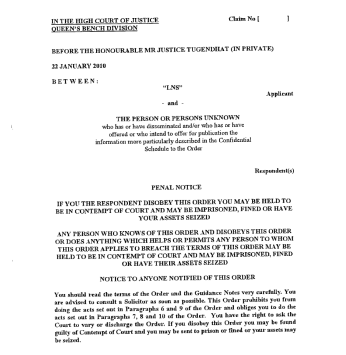 In an earlier post we mentioned a number of newspaper articles and postings about the John Terry “super-injunction” (pictured right). It continues to attract interesting and thoughtful comments from around the world. Continue reading
 It been reported in Guardian Media that Brad Pitt and Angelina Jolie are to sue the “News of the World” over a false front page story that they were splitting up and dividing their substantial joint wealth. Continue reading
 The coverage of the John Terry injunction saga has been eclectic but light on analysis. In the immediate aftermath, a number of articles hailed the decision as a great victory for free speech, see for example John Kampfner’s “John Terry’s attempt to gag a free press” in the Daily Mail and similar articles in the Guardian and Telegraph. Click here to see the full article. Continue reading
 The public has no faith in the Press Complaints Commission, a survey shows – and, shamefully, it operates in secret, says a media lawyer Continue reading
 The media coverage of the John Terry affair has reminded us of an important report produced by the Reuters Institute for the Study of Journalism. The report is by Stephen Whittle and Glenda Cooper and is entitled “Privacy, Probity and the Public Interest”.
The authors have interviewed lawyers, academics, journalists, bloggers and those who have found their privacy invaded by the media. Their findings include the following: Continue reading

Recent Judgments

© 2026 Inforrm's Blog
Theme by Anders Norén — Up ↑