

Let’s begin with what was said in Parliament. On Thursday 5 May 2011, the Conservative MP for Hendon Matthew Offord said
There has been much public discussion about the increasing use of super-injunctions and the ability of judges, rather than elected parliamentarians, to decide policy. Is the Leader of the House aware of the anomaly this creates if, as has been rumoured, a Member of this place seeks a super-injunction to prevent discussion of their activities? May we therefore have a debate on the use of super-injunctions, and not leave the issue to the Joint Committee on the Draft Defamation Bill, which cannot address these concerns?
We will put aside the misinformed first sentence – as we have pointed out previously on this blog there is no “increasing use of super-injunctions” and judges are not “deciding policy”, they are deciding cases (which is their job).
But note the highlighted words in the second sentence. First, Mr Offord refers only to rumours – he is not suggesting that he has any evidence. Second, he refers to an MP “seeking” an injunction – in other words he does not actually say that this MP has actually been “granted” an injunction.
Mr Offord subsequently told the “Daily Telegraph” that the application related to a “personal matter” and that he is planning to confront the MP next week. He said:
“I have heard about this from two different sources. I’m very keen to see that MPs aren’t seen to say one thing in public then behave in a different way in private. I feel that people shouldn’t be abusing these super-injunctions. I will speak to them and find whether the injunction has been taken out or not. If it has I will tell the MP that they are being hypocritical.”
In other words, Mr Offord confirms that he has no direct knowledge of the case at all and does not even know whether an injunction has been taken out.
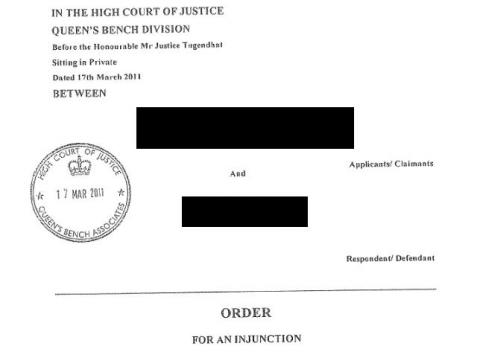
This is all a bit thin. The not always reliable political blogger Guido Fawkes, had a post entitled “Guido Knows Name of MP with an injunction, All too well” – this showed a redacted order of 17 March 2011 (pictured above). This did, indeed, involve a sitting MP – Mr Zac Goldsmith. We know because, on 22 March 2011, Mr Justice Tugendhat gave a public judgment (Goldsmith v BCD [2011] EWHC 674 (QB)) naming the MP and explaining the circumstances in which the injunction was granted. Mr Goldsmith’s sister, Jemima Khan, tweeted about this. So it wasn’t Mr Goldsmith. And it may not have been anyone at all.
It is perhaps worth revisiting some basic points to put this debate in context.
First, if a “super-injunction” (or any other kind) has been taken out then it is likely that its purpose would have been to prevent publication in the press. In order to do this it would have been necessary to serve the injunction on the newspapers. In other words, the newspapers will know, one way or the other, whether this story is true. If it were true then they would be breaking the terms of a “super-injunction” by referring to it. If the story is untrue they are misleading their readers by saying it has been granted (or, at the very least, by describing it as a “super-injunction”).
Second, if the injunction (of whatever kind) has been granted the press will know its terms and can obtain the evidence put before the court in support of it being made (all injunction orders contain such a provision). They are always entitled to apply to vary or discharge the order. If they have not done so then we can assume that the order is not hiding wrongdoing or hypocritical behaviour. If such behaviour had been involved it is highly unlikely an injunction would have been granted at all.
Third, it is difficult to understand how Mr Offord can be so clear about his charge of hypocrisy. Let’s consider a possible scenario. There is an injunction and that it restrains the publication of the contents of the MP’s stolen lap top computer which contains personal emails, photos, financial information and so (a situation which has arisen, in practice, a number of times in recent years, though not in relation to MPs). How is that hypocritical? What possible basis can there be for mentioning it in Parliament or anywhere else?
It is, of course, possible that the MP being referred to has sought and obtained an injunction to restrain the publication of a some sexual indiscretion – having presented himself to the electorate as a promoter of family values. Although “possible” this is highly unlikely because is difficult to imagine that any judge would grant an order if those facts were put before the court and, if they had not been, the media would be making an immediate application to discharge. In this possible but unlikely situation Mr Offord’s charge of hypocrisy would be made out. There are, however, a whole range of other possibilities in which no hypocrisy would be involved and an injunction would be perfectly proper.
Wouldn’t it have been sensible and responsible for Mr Offord to have made his inquiries of the MP first? Or is the desire of the MP to gain column inches by repeating the evil words “super-injunction” just too hard to resist?