

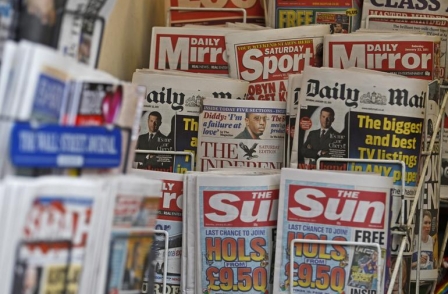
According to News International – one of the newspaper groups behind the proposals, they.
“will deliver a tough new regulator for the press that will be independent of judges and politicians. News International and its titles are supporting this initiative”.
The NI Group website has a series of short films in which editors explain News International’s position.
This proposal of a Royal Charter is another remarkable about turn by national newspapers which, in January 2013 commissioned and later published an Opinion [pdf] from Lord Pannick QC in which he criticised the Government’s proposal for a Royal Charter saying
“The fundamental defect of such a scheme would be that, in practice, Ministers would have the power to amend the Charter as and when they see fit and so there would be no protection against political interference in the future”.
No explanation has been provided as to how the new proposed Charter would overcome this “fundamental defect” (which the Government removed by a new clause in the Enterprise and Regulatory Reform Act).
According to the Newspaper Society, the proposed new charter
“is closely based on the draft Royal Charter published on 12 February which had been painstakingly negotiated with national and local newspapers and magazines, and accepted by Ministers”.
This version of the Royal Charter was, however, not accepted by Parliament which, instead, preferred a Royal Charter published on 18 March 2013 [pdf].
The industry version contains a number of very important changes to the charter agreed by Parliament – which seriously dilute the effectiveness of the new regulator. In particular:
- Arbitration is optional: Schedule 3, para 22 ‘The Board of the self-regulatory body may provide an arbitral process in relation to civil legal claims against subscribers… The Board of the self-regulatory body may consider operating a pilot scheme to test the fairness, effectiveness and sustainability of the arbitral process.’
- The Press Board of Finance (“PressBof”) is written into the Charter and has a great deal of power – Members of PressBof make up the initial Recognition Panel ( p.2, 1.1 ‘The members of the Former Pressbof shall be the first Members of the Recognition Panel’) and it has a veto over amendments to the Charter (page 4). PressBof funds the Recognition panel on an annual basis.
- Editors remain in almost total control of the Code of Practice: Press Charter, p.14, schedule 3, ‘The standards code must ultimately be adopted by the Board of the self-regulatory body, and be written by a Code Committee which is comprised of both independent members and serving editors.’
- No protection for whistleblowers: The Charter removes the obligation for the regulator to have the whistleblowing hotline, to provide guidance on the public interest, or general guidance to the public
- Third Party complaints will very difficult (Schedule 3, 11)
- No power to direct the placing of corrections and apologies: The regulator will, like the current PCC, be in the position of negotiating what sort of remedial action is suitable and have far less power to say how or where a correction or apology should be published (Schedule 3, 15 & 16).
The campaign groupd Hacked Off commented that “some newspapers showed that they had learnt nothing”. In a post on its website it said:
Editors and proprietors of some newspapers, defying the will of Parliament, have today launched a bid to block any kind of independent regulation of the press that would be capable of protecting the public from the abuses that made the Leveson inquiry necessary.
They are unilaterally rejecting the findings of a formal public inquiry that condemned newspapers for ‘wreaking havoc in the lives of innocent people’ and are threatening to set up a new regulator of their own that will inevitably be another industry poodle like the discredited Press Complaints Commission.
As part of their plan they say they will set up their regulator under a Royal Charter of their own – based on a draft document published in February that would have given editors control of every aspect of the operation.
Editors would have a veto on all appointments, they would be able to pick and choose which complaints to respond to, they would be able to bury corrections in the back pages and they would continue to write their own rule-book.
Under such a system the public could have no confidence that their complaints would be dealt with impartially because, like the fatally flawed PCC, the new body would put the interests of editors before those of ordinary people with complaints.
This desperate move by editors and proprietors – rejecting the Royal Charter agreed last month by all parties in Parliament and due to be approved by the Queen in days – is only the latest proof that most of the industry has learned no lessons from the Leveson experience. They are not sorry for the abuses exposed at the inquiry, or for the further abuses exposed almost weekly since, and they do not accept the need for real change.
This is despite abundant opinion poll evidence (which papers stubbornly refuse to report) showing that the overwhelming majority of the public wants truly independent and effective press regulation that does not interfere with free speech. That is what Leveson recommended and that is what the Royal Charter approved by Parliament will deliver.